

Every telehealth platform claims to be different. Most aren't. They offer the same checkout flows, the same portal templates, the same dashboards with the same metrics. Swap the logo and you wouldn't know which vendor you're looking at.
We built Thimble Hub because we kept running into problems that no existing platform solved. Not because they couldn't, but because their architecture made it impossible. When your platform is a monolith designed for the average case, you can't build for the operators who need something better.
Here are seven features we've shipped that few competitive B2B telehealth infrastructure platforms offer. Not as paid add-ons, not as enterprise-only upgrades. These are built into the platform because they solve problems that every telehealth operator faces.
1. Zero-Touch Checkout-to-Portal-to-Provider Handoff
On most platforms, when a patient completes checkout, someone on your team has to do something. Create an account. Assign a provider. Trigger a welcome email. Update a spreadsheet. Even platforms that claim automation typically require at least one manual step to bridge their checkout system to their clinical system.
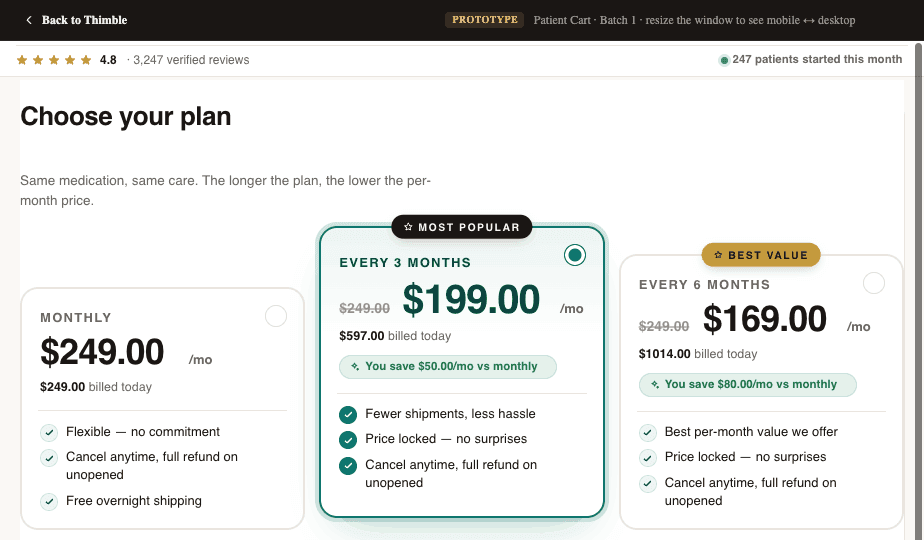
At Thimble Hub, the handoff is genuinely zero-touch. A patient completes checkout and within seconds: their account is provisioned in the patient portal, an encounter is automatically dispatched to their assigned provider network (whether that's Wizlo, OpenLoop, MDI, or CareValidate), a branded welcome email goes out with portal login instructions, and their intake data is normalized and available to the provider. No one on your team touches anything. The patient goes from 'payment confirmed' to 'ready to be seen' without a single manual step.
2. Smart GLP-1 Dosage Tracking with Brand-to-Generic Matching
If you run a GLP-1 program, you know that tracking what was prescribed versus what was actually dispensed is a nightmare. Providers prescribe brand-name Ozempic. The pharmacy fulfills with compounded semaglutide. The patient's portal shows something different from what the provider ordered, and no one can tell at a glance whether the patient is on track with their dosage progression.
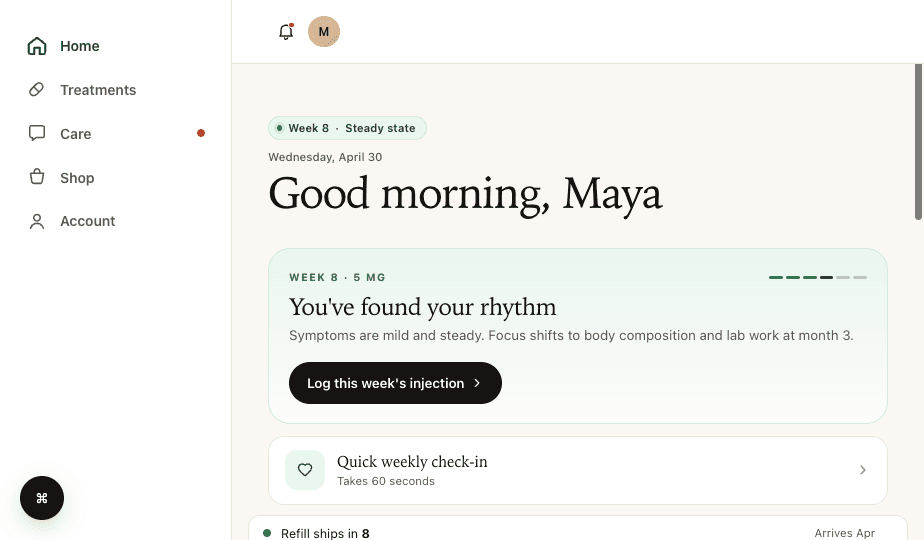
Our dosage tracking system understands the relationship between brand names, generic equivalents, and compounded formulations. When a provider prescribes Ozempic 0.5mg and the pharmacy ships compounded semaglutide 0.5mg/mL, the system recognizes those as equivalent. It tracks the patient's dosage progression per shipment, alerts your team if a provider prescribes a different dose than what was requested, and gives patients a clear view of their treatment timeline.
No other telehealth platform does this. Most don't even attempt medication tracking, let alone the brand-to-generic-to-compounded matching that GLP-1 programs require.
3. Field-Level PHI Encryption with Automated Compliance Testing
Most telehealth platforms encrypt data 'at rest and in transit,' which is the minimum HIPAA requires. What they don't do is encrypt individual fields within records. That means anyone with database access can see everything: names, diagnoses, prescription details, payment information.
Thimble Hub encrypts PHI at the field level using AES-256-GCM. Even if someone gains database access, individual protected health information fields are encrypted independently. A database administrator can see that a record exists without being able to read its clinical contents. This isn't a premium tier feature. It's the default for every plan.
More importantly, we built a PHI Guardian test suite that runs on every deployment. It automatically validates that encryption is applied correctly across every field that should be protected. Compliance isn't something we audit quarterly; it's tested on every code push.
4. Visual Automation Builder with 30+ Action Types
Most telehealth platforms offer 'automation' that amounts to triggered emails. Patient signs up, send welcome email. Payment fails, send dunning email. That's table stakes, not automation.
Thimble Hub's automation engine is a visual DAG (directed acyclic graph) builder with 30+ action types. You can build workflows with branching logic, delays, consent-aware delivery, and conditional routing. When a prescription ships, automatically email the patient, update their portal timeline, and tag them in the CRM. When a payment fails three times, escalate to a specific team member, pause the subscription, and send a personalized recovery sequence. When a patient hasn't logged into their portal in 14 days, trigger a re-engagement workflow.
This isn't an integration with Zapier. It's built into the platform with native access to patient data, subscription state, prescription status, and provider assignments. The workflows understand your telehealth business logic because they're part of it.
5. Per-Company Stripe Accounts (Your Data, Your Revenue)
Here's something most telehealth operators don't realize until they try to leave their platform: the payment data isn't yours. Most platforms process payments through their own Stripe account (or worse, their own merchant account). Your patient payment methods, subscription history, and billing relationships live in the platform's system. When you leave, you leave all of that behind. Patients have to re-enter payment information. Subscription continuity breaks. Revenue attribution data disappears.
Thimble Hub provisions a white-labeled Stripe account for each company on the platform. Your payments process through your Stripe account. Your customer data lives in your Stripe dashboard. If you ever leave Thimble Hub, your billing relationships come with you because they were always yours to begin with.
This is a structural decision that most platforms refuse to make because it reduces lock-in. We made it because it's the right thing for operators, and because we'd rather keep customers by being good than by holding their data hostage.
6. Your Dev Team, On Call
This isn't a feature in the traditional sense. It's a capability that few B2B telehealth infrastructure platforms offer because their business model won't allow it.
When you need a custom integration, a workflow that doesn't exist yet, or a feature modification specific to your business, you talk directly to our development team. Not a support ticket queue. Not a customer success manager who translates your request into a product roadmap that ships in six months. You talk to the engineers who build the platform, and the turnaround is measured in days, not quarters.
// PULLQUOTEWe scoped a custom pharmacy integration on Monday and it was live by Friday. That kind of partnership doesn't exist anywhere else.
- Thimble Hub Client
Enterprise platforms can't offer this because their support model is designed for volume: ticket queues, SLA timers, and escalation paths. We offer it because our client base is deliberately focused. We work with operators who need a build partner, not just a software vendor.
7. 90+ Lighthouse Scores as a Conversion Lever
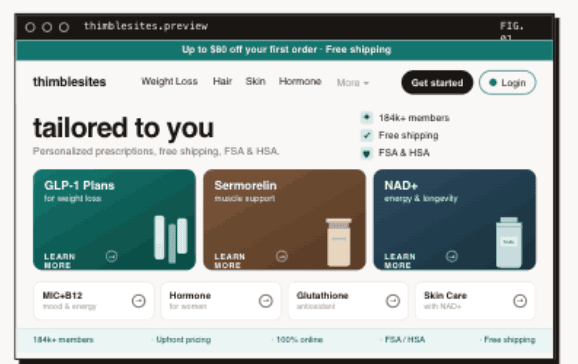
This one sounds like a technical detail until you see the revenue impact. Google's Lighthouse performance test measures how fast your site loads and how well it responds to user interaction. Most off-the-shelf telehealth sites score below 80 on Lighthouse mobile. That's not a vanity metric; it directly correlates with conversion rates. Akamai's 2017 retail benchmark found a 7% conversion drop per 100ms of added load time (e-commerce data; telehealth-specific impact varies).
Thimble Sites are engineered to score 90+ on Lighthouse out of the box, on mobile. Not after optimization. Not after a performance consultant charges you $10,000 to fix your Core Web Vitals. From launch. We achieve this through compressed image formats (AVIF and WebP), optimized font loading, minimal JavaScript bundles, and healthcare-specific structured data markup that improves both SEO and performance.
For a clinic spending $5,000 to $15,000 per month on patient acquisition, performance improvements compound meaningfully over time. Reducing page load time can lower paid acquisition costs (via improved Quality Score) and raise organic conversion rates simultaneously. Over a year, that performance gap translates into real revenue at scale.
Why These Features Don't Exist Elsewhere
It's not that other platforms can't build these things. It's that their architecture and business model prevent it. Monolithic platforms can't offer per-company Stripe accounts because their billing system is centralized. They can't offer direct dev access because their support model is built for thousands of clients, not dozens. They can't ship field-level encryption by default because retrofitting it into an existing database would require rewriting their entire data layer.
We built Thimble Hub from scratch with these capabilities as architectural foundations, not afterthoughts. That's not a marketing claim. It's a statement about what's structurally possible when you design a platform for telehealth operators who need more than the average case.
Frequently Asked Questions
- Are these features available on all pricing tiers?
- Yes. Field-level encryption, the automation builder, zero-touch handoffs, dosage tracking, and per-company Stripe accounts are included in every plan. We don't gate security or core operational features behind enterprise tiers.
- How does the zero-touch handoff work with my specific provider network?
- Thimble Hub has native integrations with Wizlo, OpenLoop, MD Integrations, and CareValidate. When a patient completes checkout, the system automatically creates an encounter with your configured provider network using their API. If you use a network we don't yet integrate with, our dev team can build the integration, typically within a week.
- What does 'direct dev access' actually mean in practice?
- It means you have a direct communication channel with the engineers who build and maintain the platform. When you need a custom integration or a workflow modification, you describe what you need and we scope and build it. Most custom requests are delivered within one week. There's no ticket queue or feature request backlog to wait in.
- How is the visual automation builder different from using Zapier?
- Zapier connects separate systems through webhooks with limited context. Thimble Hub's automation builder is native to the platform, which means workflows have full access to patient data, subscription state, prescription status, provider assignments, and portal activity. You can build branching logic based on clinical and operational data that Zapier simply doesn't have access to.
- What happens to my Stripe account if I leave Thimble Hub?
- Nothing. It's your Stripe account. Your customer payment methods, subscription history, and billing relationships remain in your Stripe dashboard. You can connect it to any other system or continue using it independently. There is no data migration required for billing because the data was never ours to begin with.
Building a telehealth brand?
Thimble Hub gives you the checkout, intake, patient portal, and EHR-routing infrastructure so you can launch in weeks, not quarters. Modular, HIPAA-ready, no lock-in.