

Patient acquisition cost in telehealth has been climbing steadily. Hims & Hers, the largest DTC telehealth brand, had a CAC of approximately $929 in 2024 (analyst-derived from H&H 2024 marketing spend divided by new subscriber additions; not a directly-disclosed metric), sustainable only because their 85% retention rate produces strong lifetime value.
For most telehealth operators who don't have Hims & Hers' retention numbers, that CAC would be fatal. Understanding what drives acquisition cost, what the benchmarks are for your vertical, and which levers actually reduce CAC is the difference between a profitable program and one that's subsidizing patient growth with investor money.
Current CAC Benchmarks by Vertical
Based on operator programs we've worked with, vertical CAC ranges typically:
- GLP-1 / Weight Loss: $200-$500+. Highest competition, highest CPMs on Meta and Google, but also highest patient lifetime value potential
- TRT / HRT / Men's Health: $150-$350. Strong subscription economics partially offset by high competition in certain demographics
- Mental Health: $100-$300. Broad audience, varied competition depending on condition specificity
- Dermatology / Skin Care: $80-$200. Lower CPMs, asynchronous visits reduce clinical costs
- General Wellness / Longevity: $100-$250. Emerging category with less ad competition but smaller addressable audience
- Overall target: Whatever produces a 3:1 or better LTV:CAC ratio with a payback period under 12 months
The 7 Levers That Actually Reduce Telehealth CAC
1. Fix Your Checkout Conversion Rate
This is the highest-leverage CAC reduction strategy because it requires zero additional ad spend. If you're converting 35% of checkout starts to completed payments and you improve to 50%, your effective CAC drops by 30%. Same traffic, same ad spend, more patients.
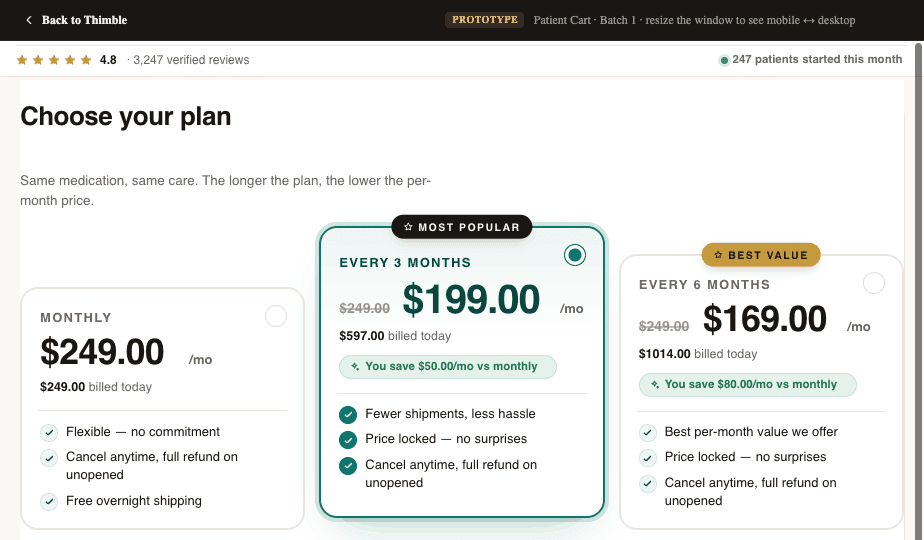
Common checkout fixes: reduce plan options to 2-3 clear choices, move medical intake post-payment, add healthcare-specific trust signals, optimize for mobile, and ensure page load under 2 seconds.
2. Improve Landing Page Quality Score
Google and Meta both use landing page quality to determine ad costs. A fast, relevant, well-designed landing page lowers your CPC, which directly lowers CAC. We've seen operators reduce Google Ads CPC by 15-25% simply by improving landing page speed and relevance.
3. Server-Side Conversion Tracking
Browser-based pixels miss 20-40% of conversions due to ad blockers and cookie restrictions. When your ad platforms can't see conversions, their algorithms can't optimize toward the right audience. Implementing Google's Conversions API and Meta's CAPI feeds more data to the algorithms, improving ad targeting and reducing wasted spend.
4. Organic Content and SEO
Paid channels are a treadmill: stop spending and traffic stops. Organic content (blog posts, condition-specific pages, educational resources) compounds over time. The CAC for an organic patient is effectively $0 marginal cost once the content ranks.
Target long-tail keywords specific to your vertical. For a GLP-1 program, content around 'semaglutide side effects,' 'GLP-1 weight loss timeline,' or 'telehealth weight loss program' can drive high-intent organic traffic within 3-6 months.
5. Referral Programs
Patients acquired through referrals from existing patients typically have the lowest CAC and the highest retention. A simple referral incentive ($50 credit for both referrer and referee) can produce patients at $50-$80 CAC with significantly better retention than paid channels.
6. Retargeting and Abandoned Checkout Recovery
Patients who started your checkout but didn't finish are the warmest possible audience. Retargeting them via email, SMS, and paid ads is dramatically cheaper than acquiring cold traffic. Abandoned checkout email sequences alone can recover 10-15% of dropped patients.
7. Channel Diversification
Don't over-concentrate on a single channel. Google and Meta are the defaults, but TikTok, YouTube, podcast sponsorships, and healthcare-specific marketplaces can all produce patients at different CAC levels. Test and measure LTV by channel to find the optimal mix.
What Doesn't Work
- Lowering prices to reduce perceived barrier. This attracts price-sensitive patients who churn faster, actually worsening unit economics
- Spending more on the same channels. Increasing budget on a channel with diminishing returns just raises your average CAC
- Complex attribution models. Multi-touch attribution sounds sophisticated but rarely produces actionable insights for telehealth operators at typical scale. Start with last-click attribution and add complexity only when you need it.
- Ignoring retention. A 10% improvement in 90-day retention is worth more than a 10% reduction in CAC for most programs. Don't optimize acquisition in isolation.
The Bottom Line
Telehealth CAC is rising across every vertical, and it won't stop. The operators who thrive are the ones who attack CAC from multiple angles: higher checkout conversion, better ad efficiency through site speed and tracking, organic content that compounds, referral programs, and abandoned checkout recovery.
But the most important insight is this: don't optimize CAC in isolation. A patient acquired cheaply who churns in 30 days is worth less than a patient acquired expensively who stays for 18 months. Track LTV by channel, and invest in the sources that produce the most valuable patients, even if their CAC is higher.
Frequently Asked Questions
- What is a good patient acquisition cost for telehealth?
- There's no universal 'good' CAC; it depends on your LTV. The target is a 3:1 or better LTV:CAC ratio with payback under 12 months. For GLP-1 programs, this typically means CAC under $500 with strong retention. For lower-ARPU verticals like dermatology, CAC needs to be under $150-$200.
- How do I calculate telehealth LTV?
- LTV = (average monthly revenue per patient) × (average subscription lifetime in months) × (gross margin %). For example: $199/month × 8 months average × 55% margin = $876 LTV. Compare this to your CAC by channel to understand unit economics.
- Which marketing channel has the lowest telehealth CAC?
- Referral programs typically produce the lowest CAC ($50-$80 per patient) with the best retention. For paid channels, it varies: Google tends to be more expensive per click but higher intent; Meta tends to be cheaper per click but lower intent. The real answer requires tracking LTV by channel, not just upfront CAC.
Building a telehealth brand?
Thimble Hub gives you the checkout, intake, patient portal, and EHR-routing infrastructure so you can launch in weeks, not quarters. Modular, HIPAA-ready, no lock-in.