

The global telehealth market is large and growing rapidly - various sources project it in the $1-2 trillion range by the mid-2030s, though figures vary widely depending on methodology. What's clear is that consumer demand for convenient, branded virtual care continues to accelerate, and the window for well-positioned white-label operators is wide open.
White-label telehealth has emerged as the fastest path to market because it separates what you're good at (brand, marketing, patient acquisition, vertical expertise) from what you'd otherwise need to build from scratch (clinical infrastructure, compliance, technology). Instead of hiring doctors, building an EMR, and getting LegitScript certified from a cold start, you assemble proven components under your brand.
This guide is the practical playbook. Not theory, not market projections. The specific steps, decisions, and timeline for launching a white-label telehealth brand in 2026.
What 'White-Label Telehealth' Actually Means
White-label means the patient sees your brand at every touchpoint: your website, your checkout, your patient portal, your email communications. Behind the scenes, specialized partners provide the clinical, pharmaceutical, and technical infrastructure.
The patient experience is entirely yours. The complexity is distributed across partners who do each piece at scale. Done well, the result is indistinguishable from a vertically integrated operation at a fraction of the cost and timeline.
The 7 Components You Need to Launch
1. Clinical Vertical and Regulatory Strategy
Before you touch any technology, you need to decide what you're treating and understand the regulatory landscape. Not all telehealth verticals are created equal.
- GLP-1 / Weight Loss: Highest demand, highest competition, significant regulatory complexity after the 2025 compounding crackdown
- TRT / HRT / Men's and Women's Health: Strong subscription economics, less regulatory volatility than GLP-1
- Mental Health: Large market, DEA telehealth flexibilities extended through 2026 for controlled substances
- Dermatology / Skin Care: Asynchronous visits work well, lower clinical complexity
- General Wellness / Longevity: Emerging category, fewer regulatory constraints, growing consumer interest
2. Provider Network
Your provider network supplies the licensed clinicians who see patients under your brand. Leading options include OpenLoop (best for scale), Wizlo (all-in-one bundling), MDI (API-first, physician-led), and CareValidate (strong credentialing and compliance focus). Each has different strengths depending on your volume, vertical, and how much you want to own vs. outsource.
Key questions: Do they cover all 50 states? Do they have protocols for your clinical vertical? What's the per-visit cost structure? How do they handle e-prescribing and pharmacy routing? Can you switch later without rebuilding everything?
3. Marketing Website
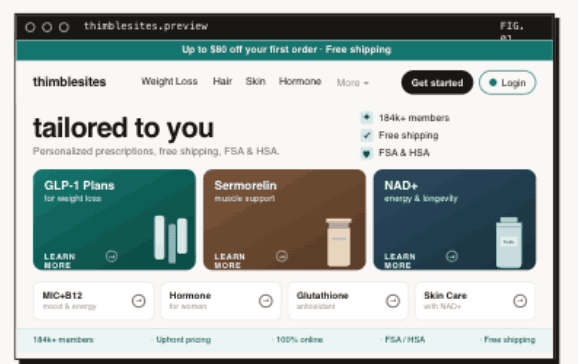
Your website is the front door. In telehealth, it needs to do more than look good. It needs to convert visitors into patients while meeting compliance requirements for LegitScript certification and platform advertising approval.
- Mobile-first design (the majority of telehealth traffic is mobile)
- Page speed under 2 seconds (directly impacts conversion and ad quality scores)
- Compliant content for LegitScript and platform advertising review
- Clear pricing, provider credentials, and treatment process explanation
- SEO-optimized for your vertical's target keywords
- Conversion-optimized CTAs and patient journey
4. Checkout and Intake Flow
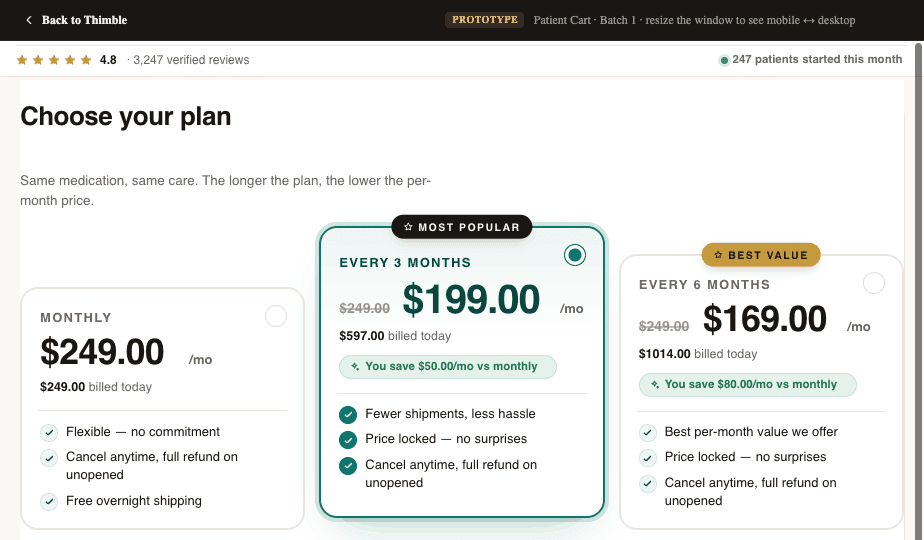
This is where most telehealth businesses leave money on the table. A purpose-built checkout handles plan selection, medical intake, payment processing, and data routing to downstream systems (provider network, CRM, pharmacy) in a single flow. Generic checkouts can't do this without extensive customization.
5. Patient Portal
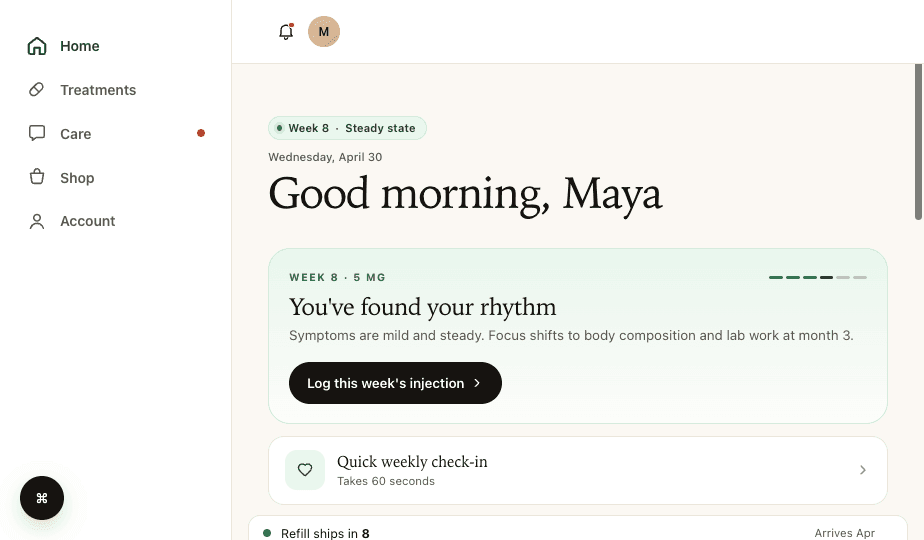
Once a patient pays, the portal becomes your product. Medication tracking, messaging, refills, subscription management, and progress monitoring all live here. This is where retention is won or lost.
6. Pharmacy Fulfillment
Your provider network typically handles e-prescribing, but you need a pharmacy fulfillment partner for medication delivery. Options include Alto Pharmacy and specialized compounding pharmacies (for verticals that require it), as well as mail-order and specialty pharmacies for brand-name medications. The integration between your provider network, pharmacy, and patient portal must be seamless. Patients expect real-time shipment tracking.
7. Analytics and Attribution
From day one, you need to know where patients come from, what they cost to acquire, how they convert, and how long they stay. This means proper UTM tracking, conversion event firing, and clean data flow from ad click to checkout to subscription retention.
Build vs. Buy: A Realistic Decision Framework
For each component, you have three options: build custom, use an all-in-one platform, or use modular infrastructure (purpose-built tools that work together but aren't coupled).
- Custom build: Maximum control, 6-12 month timeline, requires a full engineering team, $250K-$500K minimum. Only makes sense if technology is your competitive advantage.
- All-in-one platform: Fastest initial launch, but locks you into one vendor's decisions about features, pricing, and integrations. Switching costs are high.
- Modular infrastructure: Each component is purpose-built and independently replaceable. Launches in 4-8 weeks. Preserves flexibility to swap any layer without rebuilding others.
Realistic Timeline: Idea to First 100 Patients
- Weeks 1-2: Vertical selection, provider network evaluation, brand and domain setup
- Weeks 3-4: Website design and development, LegitScript application submitted
- Weeks 4-6: Checkout and intake flow built, provider network integration completed
- Weeks 6-8: Patient portal configured, pharmacy fulfillment integrated, end-to-end testing
- Weeks 8-10: LegitScript certification received, ad accounts approved, soft launch with organic and referral traffic
- Weeks 10-14: Paid advertising live, optimization cycle begins, first 100 patients
This timeline assumes modular infrastructure and an experienced build partner. Custom builds typically take 6-12 months to reach the same milestone.
Unit Economics: What the Numbers Need to Look Like
Before launching, model your unit economics carefully. The benchmarks for a sustainable DTC telehealth brand:
- Target patient acquisition cost (CAC): $100-$250 for non-GLP-1 verticals, $200-$500+ for GLP-1
- LTV:CAC ratio of at least 3:1 for sustainable growth
- CAC payback under 12 months (ideally under 6)
- Monthly subscription revenue per patient: $99-$299 depending on vertical
- Target 90-day retention: 70%+ for profitability
- Gross margin after provider costs, pharmacy, and platform fees: 40-60%
The Bottom Line
Launching a white-label telehealth brand in 2026 is more accessible than ever, but the operators who succeed are the ones who get the architecture right from the start. Choose a provider network that fits your scale and vertical. Build patient-facing infrastructure (website, checkout, portal) that's independent from your clinical layer. Get LegitScript certified before you need it. And model your unit economics before you spend a dollar on ads.
The market is massive and growing. The infrastructure is mature. The window for well-executed DTC telehealth brands to capture market share is wide open, but the brands that launch fastest with the best patient experience will win.
Frequently Asked Questions
- How much does it cost to launch a white-label telehealth brand?
- Using modular infrastructure, expect $15,000-$40,000+ for initial setup (website, checkout, portal) depending on which modules you start with, plus provider network costs. All-in-one platforms may have lower upfront costs but often come with ongoing fees and less flexibility. Custom builds start at $250,000+ and take 6-12 months.
- Do I need to be a doctor to start a telehealth company?
- No. White-label provider networks supply the licensed clinicians. You need a business entity, a medical director (required in most states; your provider network can often help with this), and compliance infrastructure. The operator role focuses on brand, marketing, patient experience, and business operations.
- How long does it take to get LegitScript certified?
- Standard processing is 4-8 weeks. Complex applications can take 2-4 months. Start the application as early as possible, ideally while your website is being built, because you can't run ads on Google, Meta, or TikTok without it.
- What's the biggest risk in launching a white-label telehealth brand?
- Regulatory risk. The telehealth landscape changes frequently: DEA rules, FDA guidance on compounding, state licensing requirements, and LegitScript standards all evolve. Build on infrastructure that lets you adapt quickly (modular architecture, flexible provider relationships) rather than infrastructure that locks you into a single approach.
Building a telehealth brand?
Thimble Hub gives you the checkout, intake, patient portal, and EHR-routing infrastructure so you can launch in weeks, not quarters. Modular, HIPAA-ready, no lock-in.