

The FDA resolved the semaglutide shortage, removed it from the Drug Shortage List, and sent thousands of warning letters to compounding pharmacies. Courts issued temporary restraining orders. Hims sued the FDA. Litigation is ongoing. But the direction is clear: compounded semaglutide's days as a guaranteed revenue stream are numbered.
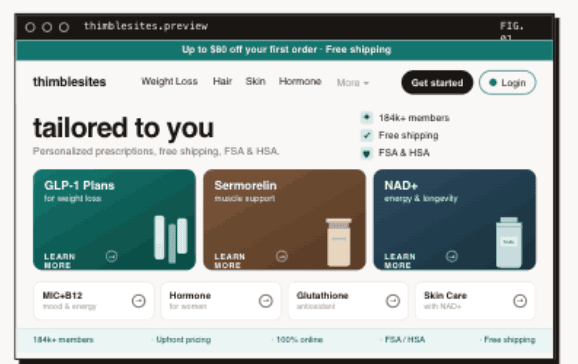
If your brand depends on compounded GLP-1s for 50%+ of revenue, you need a GLP-1 brand diversification plan that doesn't require rebuilding your infrastructure from scratch. The good news: the intake, encounter, Rx, pharmacy routing, delivery, and refill pipeline you already run for GLP-1s applies to every other DTC Rx vertical. A DTC Rx vertical pivot to men's health, HRT, or longevity is a configuration change, not a rebuild. The pipeline is the same. The product mapping changes.
The Regulatory Reality for Compounded GLP-1s in 2026
- FDA position: Semaglutide is no longer in shortage. Compounding pharmacies should stop producing compounded versions within the transition period. The FDA considers compounded semaglutide 'essentially a copy' of a commercially available drug.
- Industry pushback: The Outsourcing Facilities Association (OFA) and individual compounders have filed lawsuits. The OFA filed suit on February 24, 2025 in the Northern District of Texas challenging the shortage determination. Courts denied the preliminary injunction on April 24, 2025 - compounders lost that round.
- Current status (early 2026): Litigation is active. Some compounding continues under court protection. But no operator should build a 3-year plan assuming compounded semaglutide will remain available.
- Novo Nordisk: Aggressively pursuing legal action against compounders with cease-and-desist letters and lawsuits. They have the resources to sustain this pressure indefinitely.
- What happens to patients: Many will transition to brand-name Wegovy or Ozempic. Novo Nordisk launched NovoCare Pharmacy in early 2025 offering self-pay access at reduced prices (introductory and ongoing pricing has varied; list price is approximately $1,349/package). Many patients will still churn on cost. The brands that retain them are the ones that offer alternative treatment pathways.
The Compounded Semaglutide Alternatives: Verticals You Can Enter in 30 Days
The question most GLP-1 operators ask is: if compounded semaglutide is restricted, what do I offer patients instead? The answer is not a single compounded semaglutide alternative. It is a portfolio of verticals that reactivate your existing compounding pharmacy relationships and serve many of the same patients. Every vertical below uses the same prescription commerce pipeline your GLP-1 brand already runs. The infrastructure doesn't change. You configure new products, connect to appropriate pharmacy partners, update your clinical protocols, and launch.
Men's Health: ED, Hair Loss, TRT
A $4-5 billion DTC market. Sildenafil and finasteride are non-controlled, prescribable via async telehealth, and available through the same compounding pharmacies you already work with. Compounded chewable ED tablets and topical finasteride/minoxidil combinations use the same fulfillment pipeline as your GLP-1 shipments. Customer acquisition costs are $80-300 depending on channel. Subscriptions run $15-90/month.
TRT (testosterone) is higher complexity (Schedule III, requires video consult and labs) but also higher LTV ($99-199/month, 24-60 month average lifetime). If your brand already has DEA-aware infrastructure, TRT is a natural extension.
Women's HRT and Bioidentical Hormones
An estimated 50-60 million American women are peri- or postmenopausal. A large share do not receive HRT despite being candidates for it. The DTC menopause market is growing rapidly (industry estimates vary; treat specific figures as rough indicators). Compounded bioidentical HRT (custom estradiol, progesterone, testosterone, DHEA formulations) requires the same compounding pharmacy relationships you already have for GLP-1s. If your compounding partner makes semaglutide, they almost certainly compound hormones too.
Subscription value is high: $100-250/month for comprehensive BHRT. Patient lifetime is 18-48 months. And critically, HRT compounding is not under the same FDA pressure as GLP-1 compounding because there is no 'shortage resolution' issue. Bioidentical hormone combinations are patient-specific formulations, not copies of a commercially available product.
Prescription Skincare
Compounded tretinoin subscriptions at $25-50/month. The same compounding pharmacies, the same subscription billing, the same refill automation. Curology proved the model works at scale. The regulatory environment is the simplest of any Rx vertical: no controlled substances, async telehealth in all states, minimal lab requirements.
Longevity Prescriptions
Rapamycin, metformin, NAD+, sermorelin. One of the fastest-growing DTC Rx verticals. Higher subscription value ($200-500/month) with longer patient lifetimes. Rapamycin and metformin are non-controlled generics. NAD+ and sermorelin are compounded. This vertical has the highest revenue potential per patient but requires more clinical depth (labs, biomarker tracking, dose adjustments).
Sleep and Gut Health
Trazodone for sleep ($20-35/month) and low-dose naltrexone for gut health and inflammation ($30-60/month). Both are non-controlled. LDN requires compounding (standard 50mg naltrexone compounded down to 1.5-4.5mg), so your compounding pharmacy relationships apply directly. These are natural adjacencies: many GLP-1 patients also have sleep issues and gut health concerns, making them easy cross-sells to your existing patient base.
How to Execute the DTC Rx Vertical Pivot
Week 1: Clinical Protocols and Pharmacy Confirmation
- Work with your medical director to create prescribing protocols for 1-2 new verticals
- Confirm your compounding pharmacy partners can fulfill the new product categories (they almost certainly can)
- Confirm your provider network is licensed and willing to prescribe in the new categories
- Update intake questionnaires for the new verticals
Week 2: Infrastructure Configuration
- Configure new product SKUs in your platform (product name, dosage options, pricing, pharmacy routing rules)
- Set up new intake flows for each vertical
- Build automation sequences for the new verticals (onboarding, refill reminders, follow-up scheduling)
- Update your site and checkout to offer the new products
Week 3: Soft Launch to Existing Patients
- Email your existing patient base about the new offerings. Your GLP-1 patients already trust your brand. They are the highest-conversion audience for your new verticals.
- Offer existing patients a discount on their first month of a new product (cross-sell economics are dramatically better than new patient acquisition)
- Monitor the end-to-end flow for each new vertical: intake, provider review, pharmacy fulfillment, delivery, refill
Week 4+: External Marketing
- Launch paid acquisition for the new verticals independently
- Update SEO content to target new vertical keywords
- Build content (blogs, social, email) around the new product categories
- Track unit economics per vertical and double down on the highest-performing ones
The Revenue Math: Diversification vs Concentration
A GLP-1 brand doing $100K/month with 100% concentration in compounded semaglutide is one FDA ruling away from zero revenue. A brand doing $100K/month across four verticals (GLP-1, men's health, HRT, skincare) loses 25% if GLP-1 compounding gets shut down. The remaining 75% continues growing.
- Scenario A (concentrated): $100K/month from GLP-1. FDA shuts down compounding. Revenue drops to $0-20K/month (only patients who switch to brand-name). Recovery takes 6-12 months.
- Scenario B (diversified): $40K GLP-1 + $25K men's health + $20K HRT + $15K skincare. FDA shuts down compounding. Revenue drops to $60-65K/month. You've already built the acquisition channels for the other verticals. Recovery takes 30-60 days.
What Your Compounding Pharmacy Partner Already Makes
Most 503A and 503B compounding pharmacies that produce semaglutide also compound all of the following. Ask your existing pharmacy partner about adding these products:
- Bioidentical hormones: estradiol, progesterone, testosterone (all strengths and forms)
- Skincare: tretinoin, azelaic acid, niacinamide, hydroquinone combinations
- ED medications: sildenafil and tadalafil chewables, sublingual troches
- Hair loss: topical finasteride/minoxidil combinations
- Longevity: NAD+ injectable, sermorelin, low-dose naltrexone
- Sleep: compounded trazodone (though generic tablets are usually sufficient)
Your pharmacy relationship is the asset. The specific compound they mix is the variable. Redirecting capacity from semaglutide to other products is operationally straightforward for most compounders.
Frequently Asked Questions
- Can I add new Rx verticals without changing my platform?
- Yes, if your platform supports configurable product routing. On Thimble Portal, adding a new therapeutic vertical is a configuration change: new product SKUs, updated intake flows, pharmacy routing rules, and automation sequences. No engineering work required. The pipeline (intake, encounter, Rx, pharmacy, delivery, refill) is identical across verticals.
- Which vertical should a GLP-1 brand diversify into first?
- Women's HRT/BHRT has the highest subscription value ($100-250/month), uses the same compounding pharmacy relationships, and is not under the same FDA compounding pressure as GLP-1s. Men's health (ED, hair loss) has the highest volume and fastest patient acquisition. Both are strong first choices for GLP-1 brand diversification.
- What is a realistic compounded semaglutide alternative?
- There is no single compounded semaglutide alternative that replicates the GLP-1 market. The realistic play is a DTC Rx vertical pivot to a portfolio of verticals: HRT, men's health, longevity, skincare. Each uses your existing compounding pharmacy relationships. Together, they can replace semaglutide revenue and reduce your exposure to any single regulatory risk.
- Is compounded semaglutide going away completely?
- The FDA has declared the shortage resolved and is moving to restrict compounding. Litigation is ongoing with temporary court orders allowing continued compounding. The outcome is uncertain, but operators should plan for a scenario where compounded semaglutide is no longer available and diversify accordingly.
- Can I cross-sell new verticals to my existing GLP-1 patients?
- Yes, and this is the most efficient growth channel for diversification. GLP-1 patients have high overlap with HRT (menopause-related weight gain), skincare (aging concerns), sleep (common comorbidity), and men's health. Cross-selling to existing patients has dramatically lower acquisition costs than new patient marketing.
- How long does it take to launch a new vertical?
- On Thimble Portal, 2-4 weeks from decision to first patient in a new vertical. Week 1: clinical protocols and pharmacy confirmation. Week 2: platform configuration. Week 3: soft launch to existing patients. Week 4: external marketing begins.
Building a telehealth brand?
Thimble Hub gives you the checkout, intake, patient portal, and EHR-routing infrastructure so you can launch in weeks, not quarters. Modular, HIPAA-ready, no lock-in.