
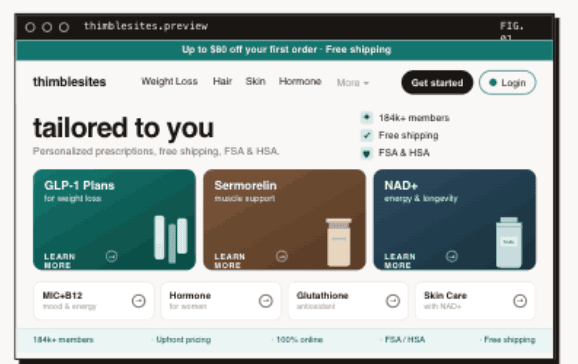
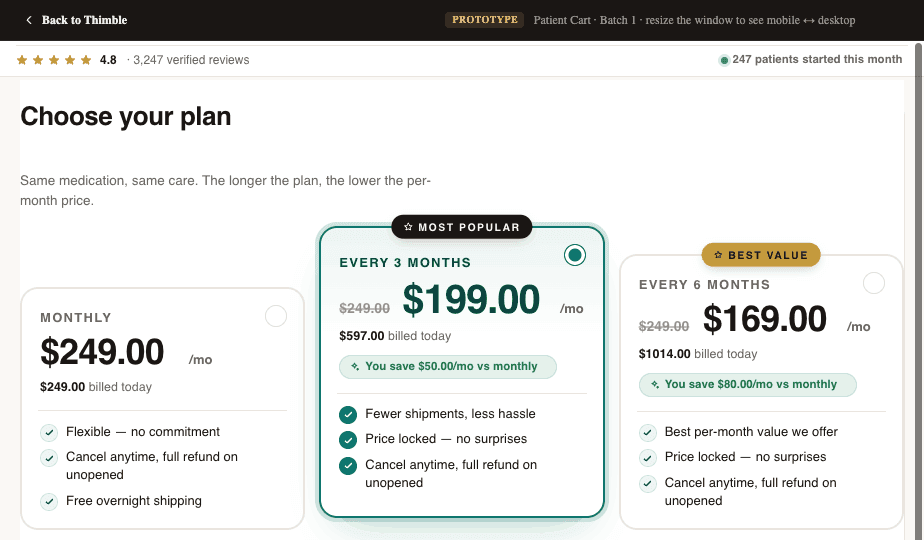
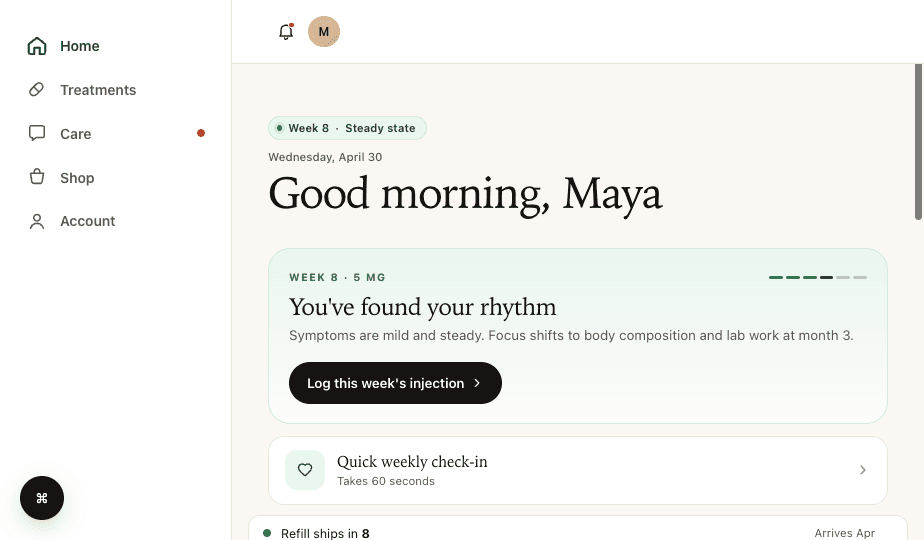

Hims invested significantly in custom infrastructure across pre-IPO funding - custom intake forms, custom telehealth platform, custom pharmacy routing, custom subscription billing, custom fulfillment tracking. Years and hundreds of millions of dollars to build undifferentiated infrastructure that every DTC medication brand needs.
Ro has raised over $1 billion and built the same thing. Cerebral raised $300 million, built a worse version, and collapsed under federal investigations. Done Health, Truepill, The Pill Club: cautionary examples of DTC Rx companies that spent venture capital on infrastructure instead of clinical quality and brand — or failed to maintain the compliance guardrails that make sustainable operations possible.
These companies collectively spent over $2 billion building functionally identical technology stacks. Intake, telehealth encounter, prescription, pharmacy routing, delivery, refill automation. The pipeline is the same whether you're prescribing sildenafil for ED, tretinoin for acne, estradiol for menopause, or semaglutide for weight loss. The only difference is the product mapping.
The Build-or-Buy Decision Every DTC Medication Brand Faces
Every entrepreneur who wants to launch a DTC medication brand faces the same decision. Build custom infrastructure from scratch (12+ months, $1M+ minimum, ongoing engineering team required) or try to stitch together 6-8 separate tools that don't talk to each other: Typeform for intake, a telehealth platform for encounters, a separate pharmacy API, Stripe for billing, Mailchimp for patient communication, and a patient portal that doesn't match your brand.
The first option is how Hims did it. The second is how most small DTC Rx brands operate today, losing patients at every handoff point between disconnected systems.
There is a third option: prescription commerce infrastructure. A platform that handles the entire pipeline from intake to refill, white-labeled to your brand, with compliance built in. You focus on your clinical approach, your brand, and your patients. The infrastructure handles everything else.
What the Prescription Commerce Pipeline Actually Looks Like
Every DTC medication brand, regardless of therapeutic vertical, runs on the same six-stage pipeline:
- 01.Intake: Patient completes a medical questionnaire, uploads photos (for dermatology), provides health history, signs consent forms. The intake system normalizes data from any form tool (Formsort, Typeform, JotForm, Embeddables) or can be built natively.
- 02.Telehealth encounter: A licensed provider reviews the intake, conducts a synchronous or asynchronous consultation, and makes a clinical decision. The provider can be from your own clinical team or from an integrated provider network (Wizlo, OpenLoop, MDI, CareValidate).
- 03.Prescription: The provider generates a prescription. The system routes it to the appropriate pharmacy based on configurable rules (compounding pharmacy for custom formulations, retail pharmacy for generics, specialty pharmacy for biologics).
- 04.Pharmacy fulfillment: The pharmacy fills the prescription and ships it to the patient. Tracking information flows back to the platform. The patient sees real-time fulfillment status in their portal.
- 05.Delivery and patient experience: The patient receives their medication and logs into a branded portal that tracks their treatment progress, dosage history, and upcoming refills. They can message their care team and manage their subscription.
- 06.Refill automation: The system handles recurring prescriptions, payment processing, renewal consultations, and smart reminders. Failed payments trigger recovery sequences. Dose adjustments are coordinated between provider and pharmacy.
This pipeline is the same for a men's health brand selling sildenafil, a menopause brand prescribing compounded bioidentical hormones, a skincare brand shipping tretinoin, or a longevity brand dispensing rapamycin. The medications change. The pipeline does not.
Why $2 Billion in Custom Stacks Failed
The Compliance Catastrophe
Cerebral raised $300 million from SoftBank, reached a $4.8 billion valuation, and prescribed ADHD stimulants through a telehealth platform with inadequate clinical guardrails. The FTC fined them over $7 million for sharing patient health data with advertisers, with the DOJ filing the final order in federal court. Their valuation collapsed over 80%.
Done Health's CEO was indicted by the DOJ for conspiracy to distribute controlled substances. The company effectively shut down.
Truepill, the pharmacy fulfillment API that was supposed to be 'Stripe for pharmacy,' received a federal DEA Order to Show Cause in December 2022, which it settled in November 2023. They laid off significant staff and were subsequently acquired in late 2024 at a substantial markdown from their $1.6 billion peak valuation.
Every one of these failures was a compliance failure. Not a technology failure. Not a demand failure. The market was there. The patients were there. The technology worked. But the compliance infrastructure was either absent or deliberately ignored in favor of growth.
The Unit Economics Problem
Building a custom prescription commerce stack requires a minimum engineering team of 8-15 engineers. At fully loaded costs of $200-300K per engineer, that's $1.6-4.5 million annually in engineering salary alone, before you see a single patient. Curology raised $112 million and still reportedly struggled with profitability. The Pill Club (DTC birth control) raised $50 million and shut down.
The math only works at massive scale. Hims can justify $100 million per year in technology spend because they process hundreds of millions in revenue. A new brand doing $2 million per year in revenue cannot afford its own engineering team, let alone the compliance, pharmacy, and provider network infrastructure.
The Verticals That Run on This Pipeline
The prescription commerce pipeline applies to every DTC medication vertical. Here are the markets where new brands are launching right now:
Men's Health: ED, Hair Loss, Testosterone
Hims generated $2.35 billion in revenue in FY2025. Ro has raised over $1 billion. BlueChew is doing an estimated $150-250 million. The market is proven but the infrastructure barrier has kept the competitive set small. A new men's health brand can launch on prescription commerce infrastructure and compete on brand and clinical approach rather than trying to out-engineer Hims.
Women's Health: Menopause and Bioidentical HRT
55 million American women (per NAMS estimates) are peri- or postmenopausal. Only 15% receive HRT. The broader menopause market is estimated at $18 billion globally (multiple sources); the DTC sub-segment size varies widely by source. Compounded bioidentical HRT (the highest-growth segment) requires exactly the infrastructure Thimble Portal provides: intake, provider encounter, compounding pharmacy routing, delivery, and refill management.
Prescription Skincare
Curology pioneered the compounded tretinoin subscription and grew to an estimated $200-300 million in revenue. The model works, but the $20-40 price point makes custom infrastructure economically impossible for new entrants. Infrastructure that amortizes development costs across many brands makes the economics viable at any scale.
Longevity and Anti-Aging Prescriptions
The fastest-growing DTC Rx vertical, estimated at 40-60% annually based on industry projections. Rapamycin, metformin, NAD+, and remaining legal peptides like sermorelin. The FDA's peptide crackdown (BPC-157, TB-500 effectively banned from compounding in 2024-2025) destroyed dozens of companies overnight. The brands that survived are the ones with infrastructure flexible enough to adapt when products get pulled.
Sexual Health, Sleep, Migraine, Thyroid, Fertility
PrEP subscriptions ($2-3 billion market). Trazodone-based sleep programs (no dominant DTC brand exists). Triptan subscriptions for migraine. Levothyroxine for thyroid. Progesterone and letrozole for fertility. Every one of these uses the same intake, encounter, Rx, pharmacy, delivery, refill pipeline. The medication changes. The infrastructure does not.
Who Launches on Prescription Commerce Infrastructure
- Physicians and clinicians launching their own branded telehealth medication service. They have the clinical expertise. They need the commerce layer.
- Compounding pharmacies going direct-to-consumer. There are ~7,500 503A compounding pharmacies in the US. Many built DTC capability for semaglutide and now need to redirect into HRT, skincare, men's health, and peptides. They have the medications. They need the patient-facing infrastructure.
- Health and wellness entrepreneurs entering prescription health from the supplement space. The progression from supplements to compounded medications to prescriptions is a natural evolution. They need compliant Rx infrastructure.
- Private equity firms rolling up DTC telehealth brands. Warburg Pincus, KKR, and TPG are reportedly exploring telehealth acquisitions. When they buy 3-5 brands, they need a unified multi-brand platform. Not 3-5 custom stacks.
- Employers wanting to offer branded pharmacy benefits (GLP-1, mental health, cessation programs) at lower cost than traditional PBM channels.
- Health systems launching DTC-style programs to recapture patients they're losing to Hims and Ro. They have clinical expertise and brand trust. They lack consumer-grade commerce technology.
What Prescription Commerce Infrastructure Includes
The infrastructure stack that every DTC medication brand needs, built once and shared across brands:
- Multi-pharmacy routing: Route prescriptions to compounding pharmacies, retail pharmacies, or specialty pharmacies based on configurable rules per product, per state, per patient preference
- Provider network integration: Connect to Wizlo, OpenLoop, MDI, CareValidate, or your own clinicians. Match patients to state-licensed providers automatically.
- White-label patient portal: Your brand, your domain, your colors. Treatment tracking, messaging, refill management, document storage. Patients never see the platform vendor.
- Stripe Connect billing: Per-brand Stripe accounts. Your patient payment data belongs to you. Subscription management, payment recovery, proration, plan changes.
- Automation engine: 30+ trigger and action types in a visual workflow builder. New patient onboarding sequences. Refill reminders. Payment failure recovery. Lab follow-up workflows. Consent-aware delivery with conditional branching.
- Compliance infrastructure: Field-level AES-256-GCM encryption on all data models. Six-year immutable audit trails. MFA enforcement. Automated compliance testing on every deployment. BAAs included.
- State-by-state regulatory engine: Telehealth prescribing rules, pharmacy licensure, controlled substance handling (where applicable). Built once, maintained centrally, applied to every brand.
- Analytics: Revenue, retention, cohort analysis, churn risk, acquisition channel performance, clinical metrics. 8 specialized dashboards that give you business intelligence most DTC Rx brands never build.
The Market Opportunity
DTC prescription health across all verticals is a large and growing market - industry estimates vary widely, but the direction is clear. If platform infrastructure captures 10-15% of GMV (the Shopify benchmark), prescription commerce infrastructure represents a significant and compounding opportunity.
The closest prior competitor in this space (Truepill) faced DEA compliance issues in 2022, a valuation markdown from its $1.6 billion peak, and was ultimately acquired in late 2024. The provider network players (Wheel, OpenLoop, SteadyMD) solve only one piece. The EHR platforms (Healthie) solve a different piece. Nobody offers the complete pipeline from intake to refill, white-labeled, with compliance built into every layer.
Shopify for Rx: Infrastructure, Not Competition
This is the Shopify for Rx analogy, and it holds up. Shopify didn't compete with Nike for shoe customers. Shopify is the infrastructure that lets the next Nike launch. Thimble Portal isn't competing with Hims for their patients. Thimble Portal is the prescription commerce infrastructure that lets the next Hims launch in weeks instead of years, at thousands of dollars instead of millions, with compliance built in from day one instead of bolted on after the DOJ calls.
The addressable market isn't 'people who want GLP-1s.' It's entrepreneurs, clinicians, and pharmacies who want to start a DTC prescription medication brand. That market is growing every month as new therapeutic categories open up and consumer demand for convenient, branded prescription health continues to accelerate.
Frequently Asked Questions
- What is prescription commerce infrastructure?
- Prescription commerce infrastructure is a white-label platform that handles the full DTC medication pipeline: patient intake, telehealth encounter, prescription generation, pharmacy routing, delivery tracking, refill automation, and subscription billing. It lets entrepreneurs and clinicians launch DTC medication brands without building custom technology.
- What does it cost to launch a DTC medication brand on a white label telehealth platform vs building custom?
- Building custom prescription commerce infrastructure typically costs $1-3 million in year one and requires a dedicated engineering team of 8-15 people. Launching on a white label telehealth platform like Thimble Portal costs a fraction of that (one-time build fees, not ongoing monthly platform subscriptions), and you can go from zero to live patients in weeks instead of 12+ months.
- What therapeutic verticals can run on this infrastructure?
- Any DTC medication vertical that follows the intake, encounter, Rx, pharmacy, delivery, refill pipeline. This includes weight management (GLP-1), men's health (ED, hair loss, TRT), women's health (menopause, HRT, birth control), prescription skincare, longevity, sexual health (PrEP, STI), sleep medicine, migraine, thyroid, and fertility.
- Is the infrastructure HIPAA compliant?
- Yes. Thimble Portal uses field-level AES-256-GCM encryption across all data models, enforces MFA for all admin and clinical roles, maintains six-year immutable audit trails, and runs automated compliance testing on every deployment. BAAs are included with every plan.
- Can compounding pharmacies use this to launch DTC brands?
- Yes. Compounding pharmacies that have the medications but need patient-facing infrastructure are one of the primary use cases. Thimble Portal provides the intake, telehealth encounter, billing, patient portal, and delivery tracking. The pharmacy focuses on compounding and fulfillment.
Building a telehealth brand?
Thimble Hub gives you the checkout, intake, patient portal, and EHR-routing infrastructure so you can launch in weeks, not quarters. Modular, HIPAA-ready, no lock-in.