

An estimated 50-60 million American women are currently peri- or postmenopausal. A large share of those who could benefit from hormone replacement therapy do not receive it. That gap represents one of the largest underserved markets in healthcare, and it's closing fast.
The global HRT market is sizable and growing. The DTC telehealth segment is the fastest-growing slice. Celebrity advocacy (Oprah, Naomi Watts, Drew Barrymore), shifting medical consensus, and state-level legislation mandating menopause care coverage have all accelerated demand.
The market opportunity is well-documented. What's been missing is prescription commerce infrastructure built specifically for the compliance requirements of compounded HRT. That's changed.
Why a DTC Menopause Brand or Bioidentical HRT Business Is Worth Building Now
- Massive undertreatment: A large majority of eligible women don't receive HRT, largely because their primary care providers are not trained in menopause management. DTC telehealth bypasses this bottleneck.
- High subscription value: HRT is typically a multi-year treatment. Compounded bioidentical HRT subscriptions run $100-250/month. That's 3-5x the average DTC men's health subscription.
- Compounding is the differentiator: Compounded bioidentical HRT (custom estradiol, progesterone, testosterone, DHEA formulations) is the fastest-growing segment. It requires compounding pharmacy infrastructure that retail pharmacies cannot provide. This is your moat.
- Cultural momentum: Menopause went from taboo to mainstream in 2024-2025. Media coverage, celebrity advocacy, and employer benefit expansion have created demand that far exceeds supply of quality providers.
- Regulatory simplicity: Estradiol, progesterone, and most HRT medications are non-controlled substances. They're prescribable via telehealth with no DEA complications. The exception is low-dose testosterone for women (Schedule III), but it's typically prescribed as a compounded cream at doses well below the threshold that triggers aggressive DEA scrutiny.
The Competitive Landscape
- Midi Health (publicly reported funding rounds; verify): Insurance-based menopause telehealth. Strong clinical team. But the insurance model means restricted formularies and slower patient access.
- Alloy (publicly reported funding rounds; verify): DTC cash-pay menopause. Subscription HRT. Good brand but limited automation and patient engagement infrastructure.
- Evernow (publicly reported funding rounds; verify): DTC HRT with both FDA-approved and compounded options. Similar positioning to Alloy.
- Winona (publicly reported funding rounds; verify): Bioidentical HRT focus. DTC subscription model. Growing but operationally constrained.
- Hims (Hers brand): Launched a menopause and perimenopause specialty in October 2025. Mass market approach. Less specialized than dedicated menopause brands.
The market is early. No single brand dominates. And the existing players are mostly subscale, with limited automation, generic patient portals, and fragile compounding pharmacy relationships. A new brand built on proper infrastructure can compete immediately.
What You Need to Launch a DTC HRT Brand
Clinical Protocol
Menopause HRT requires more clinical nuance than ED or hair loss. Your protocol needs to address: symptom assessment (vasomotor, genitourinary, mood, sleep, cognitive), risk stratification (breast cancer history, cardiovascular risk, thromboembolism risk), lab requirements (baseline hormone panel, follow-up monitoring), dosage titration, and clear escalation pathways for complex cases.
Work with a menopause-trained medical director (ideally NAMS-certified). This is non-negotiable. The clinical quality of your protocol is your brand's credibility.
Provider Network
You need providers with specific menopause expertise, not general telehealth providers. Many OB/GYNs and PCPs are not trained in HRT management. Your provider network should include clinicians comfortable with bioidentical HRT, compounded formulations, and the nuanced risk-benefit conversations that menopause patients require.
Compounding Pharmacy Relationships
This is the operational core of a menopause brand. Compounded bioidentical HRT (custom bi-est or tri-est creams, progesterone troches, low-dose testosterone cream, DHEA) cannot come from a retail pharmacy. You need 503A or 503B compounding pharmacy partners who specialize in hormone formulations, maintain quality standards, and can scale with your patient volume.
Lab Integration
HRT typically requires baseline lab work (estradiol, progesterone, FSH, testosterone, thyroid panel, complete metabolic) and follow-up monitoring during dose titration. Your infrastructure needs to integrate with lab partners (Quest, Labcorp, or at-home collection kits like Ash Wellness) so lab ordering and results flow back into the patient record automatically.
The Products: What DTC Menopause Brands Prescribe
- Estradiol (patch, gel, cream, oral): The foundation of HRT. Available as FDA-approved generics or compounded formulations. Patches run $30-60/month; compounded creams $50-100/month.
- Progesterone (Prometrium generic, compounded troches/suppositories): Required for women with a uterus to protect against endometrial hyperplasia. $30-80/month.
- Compounded bi-est or tri-est (estradiol + estriol combinations): The premium BHRT product. Custom formulated per patient based on symptoms and lab results. $60-120/month.
- Low-dose testosterone (compounded cream): For libido, energy, and cognitive symptoms. Off-label for women (no FDA-approved testosterone product for women exists). Schedule III, so DEA rules apply. $40-80/month.
- DHEA (compounded or OTC): For vaginal health and general hormone optimization. $30-60/month.
- Vaginal estrogen (estradiol cream/ring/tablet): For genitourinary syndrome of menopause. Often prescribed alongside systemic HRT. $25-50/month.
A comprehensive BHRT subscription (estrogen + progesterone + testosterone + DHEA) typically runs $150-250/month. This is a premium product for a premium audience that values personalized care.
How the Pipeline Works
- 01.Patient discovers your brand through content marketing, social media, referral, or search. Lands on your branded site.
- 02.Symptom assessment and intake: Detailed menopause questionnaire (MRS or custom), medical history, current medications, breast cancer screening, cardiovascular risk factors. Photo upload not typically needed (unlike dermatology).
- 03.Lab ordering: Platform generates a lab order for baseline hormone panel. Patient visits a local lab or receives an at-home collection kit. Results auto-populate in the patient record.
- 04.Provider consultation: A menopause-trained provider reviews intake and labs. Conducts a synchronous video consultation (standard of care for HRT initiation). Creates a personalized treatment plan with specific formulations and dosages.
- 05.Prescription routing: Compounded HRT prescriptions route to your compounding pharmacy partner. FDA-approved products (estradiol patch, Prometrium) route to retail pharmacy. The system handles this automatically based on product type.
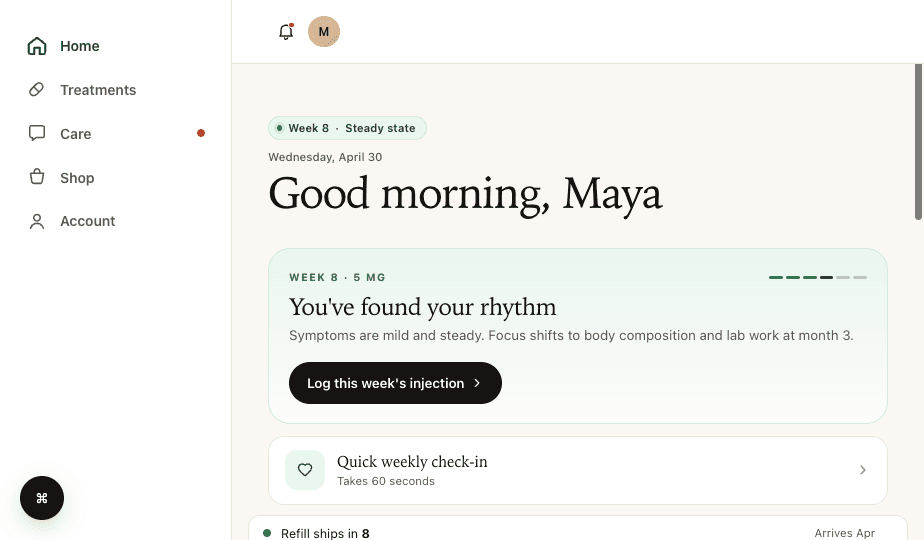
- 06.Patient portal and treatment tracking: Patient accesses a branded portal showing their hormone levels, treatment plan, medication shipment tracking, refill schedule, and messaging with their provider.
- 07.Ongoing management: Automated refills, 6-8 week follow-up lab reminders, dose adjustment workflows, annual provider reassessments. The automation engine handles the cadence; the provider handles the clinical decisions.
Positioning: Where a New DTC HRT Brand Can Win
- BHRT-first: Position as the compounded bioidentical HRT specialist. This is the highest-value, highest-retention product and the segment growing fastest. FDA-approved HRT is available at any pharmacy. BHRT requires your infrastructure.
- Community-driven: Menopause is still underserved by empathetic, community-first brands. Build a community (private groups, content, events) that goes beyond prescriptions. Women going through menopause want to feel seen, not processed.
- Comprehensive protocols: Don't just prescribe estrogen. Address the full spectrum: hot flashes, sleep, mood, cognition, bone health, vaginal health, libido, skin. Multi-symptom management is where premium subscriptions justify $200+/month.
- Provider relationships: In a space where many women feel dismissed by their doctors, a brand that offers real provider relationships (not 5-minute async reviews) wins trust and retention.
- Education as marketing: The menopause content gap is enormous. Most women don't know what perimenopause is, that HRT is safe for most women, or that compounded bioidentical options exist. Content that educates converts at dramatically higher rates than paid ads.
Unit Economics
- Average monthly subscription: $120-250/month for comprehensive BHRT
- Cost of goods (compounding + shipping): $25-60/month
- Provider cost: $30-60 for initial video consultation; $15-30 for follow-up reviews
- Lab costs: $50-150 per panel (absorbed by patient or included in subscription, depending on pricing model)
- Customer acquisition cost: $150-400 (lower than men's health because organic content converts better in this space)
- Average customer lifetime: 18-48 months (HRT is long-term therapy)
- LTV potential: $2,000-$10,000+ per patient
Regulatory Considerations
- Most HRT is non-controlled: Estradiol, progesterone, estriol, DHEA are all non-controlled substances. Prescribable via telehealth (including asynchronous in most states, though synchronous video is the clinical standard of care for HRT initiation).
- Low-dose testosterone for women is Schedule III: Even at doses far below men's TRT, testosterone is DEA-regulated. Follow the same DEA telehealth rules (synchronous video, 180-day limits). Most DTC menopause brands prescribe compounded testosterone cream at 0.5-2mg/day, which is clinically well within standard practice.
- Compounding pharmacy regulation: 503A pharmacies compound patient-specific formulations. 503B outsourcing facilities can produce larger batches. The FDA has increased scrutiny of compounding since the semaglutide enforcement actions. Ensure your pharmacy partners are compliant and documented.
- Marketing claims: You can discuss menopause symptoms and treatment options. You cannot make specific claims about compounded BHRT being 'superior' to FDA-approved HRT without evidence. The FDA and FTC both monitor health claims in DTC advertising.
- State insurance mandates: California, New York, Minnesota, and other states have enacted or are considering legislation mandating insurance coverage for menopause treatments. This could create a hybrid cash-pay/insurance opportunity for DTC brands.
Frequently Asked Questions
- Why launch a DTC menopause brand now? How big is the market?
- The DTC telehealth menopause and HRT market is growing rapidly. An estimated 50-60 million American women are peri- or postmenopausal, and a large share who could benefit from HRT do not receive it, representing significant unmet demand. No single brand dominates the DTC segment yet, which makes 2026 early enough to establish real market position.
- Do I need a compounding pharmacy to launch a DTC HRT brand?
- For FDA-approved HRT (estradiol patches, Prometrium), no. For compounded bioidentical HRT (custom bi-est, tri-est, progesterone troches, testosterone cream), yes. Compounded BHRT is the fastest-growing and highest-margin segment. Thimble Portal handles pharmacy routing to both compounding and retail pharmacies automatically.
- Is testosterone prescribing for women complicated?
- Low-dose testosterone for women is off-label (no FDA-approved product for women) and Schedule III (DEA-regulated). The DEA telehealth rules require synchronous video consultation. At the low doses used for women (0.5-2mg/day compounded cream), prescribing is clinically well-established. Thimble Portal's compliance infrastructure handles Schedule III requirements.
- How long do menopause patients stay on HRT?
- Current medical consensus supports HRT for the duration of symptoms, which for many women is 5-10+ years. Even conservative guidelines recommend a minimum of 3-5 years for vasomotor symptoms. This makes menopause HRT one of the highest-LTV subscription verticals in DTC Rx.
- What kind of providers do I need for a menopause brand?
- You need clinicians with specific menopause training, ideally NAMS-certified (North American Menopause Society). General telehealth providers or standard OB/GYNs often lack the training to manage HRT, especially compounded bioidentical protocols. Quality of your clinical team directly impacts retention and clinical outcomes.
Building a telehealth brand?
Thimble Hub gives you the checkout, intake, patient portal, and EHR-routing infrastructure so you can launch in weeks, not quarters. Modular, HIPAA-ready, no lock-in.