

When a small clinic asks how much telehealth costs, every vendor has a different answer. Enterprise platforms quote six-figure annual contracts with 'custom pricing' that depends on how badly they want your business. DIY guides list a dozen tools without mentioning that each one requires 10 hours of integration work. And most 'cost breakdown' articles conveniently skip the biggest expense of all: the patients you lose because your system doesn't work.
This is the real breakdown for a small clinic in 2026. Actual numbers. Actual tradeoffs. Three real options compared.
The Three Cost Categories You Need to Know
Telehealth costs break down into three buckets. Most budget discussions only cover the first one, which is why most telehealth budgets are wildly inaccurate.
- 01.Direct platform costs: Software licenses, per-seat fees, transaction fees, hosting. What the vendor invoices you
- 02.Integration and labor costs: Staff time stitching together disconnected tools, manual data entry, workflow workarounds
- 03.Opportunity costs: Revenue lost to slow checkout, poor patient experience, churn, and inability to scale
When you budget only for category one, you end up with a 'cheap' setup that costs you 3x more in categories two and three. Here's what each one actually looks like.
Option 1: The DIY Patchwork Stack
This is what most small clinics do first. Sign up for individual tools, connect them with Zapier or manual processes, and pray nothing breaks.
Direct Platform Costs (Monthly)
- Video platform (Zoom for Healthcare or Doxy.me): $15-$100/provider depending on plan tier and team size
- Intake forms (Typeform, JotForm with HIPAA tier): $50-$200
- Patient portal (basic or built into EHR): $0-$500
- Scheduling software: $50-$150
- HIPAA-compliant email and SMS: $100-$300
- Integration middleware (Zapier, Make): $100-$400
- Managed IT for HIPAA compliance: $700-$2,500
- Website hosting and maintenance: $100-$300
Direct platform total: Roughly $1,150-$4,550/month for a 5-provider clinic. Scale up per-provider costs for larger practices.
Hidden Integration Costs
- Staff time stitching tools together: 10-20 hours/week at $25-$40/hour = $1,000-$3,200/month
- One-time integration setup and troubleshooting: $2,000-$10,000 spread over 6 months
- Recurring 'patch fixes' when vendors change their APIs: $500-$2,000/month in lost productivity
Opportunity Costs
- Patient churn from disconnected experience: 15-30% of patients who should stay, leave
- Ad spend waste from slow site performance: 15-25% of traffic bounces
- Provider idle time from scheduling friction: 5-15% of appointment slots unused
Option 2: The Enterprise All-in-One Platform
This is what your vendor sales rep will recommend. One platform, one contract, one login. Simple in theory.
Direct Platform Costs (Monthly)
- Base platform fee: $2,000-$8,000/month
- Per-provider licensing: $100-$400/provider/month
- Per-patient or per-encounter fees: $5-$15/encounter
- Setup and implementation: $10,000-$50,000 one-time
- Custom integrations (often mandatory): $5,000-$25,000 per integration
- Training and onboarding: $2,000-$10,000
Direct platform total for a 10-provider clinic: Roughly $5,000-$12,000/month after setup. Plus $15,000-$75,000 upfront.
Hidden Costs
- Per-seat fees scale linearly with team growth (double your providers, double your costs)
- Feature requests go into a 6-12 month product roadmap queue
- Custom workflows require professional services billed at $200-$400/hour
- Contract lock-in (typically 2-3 years) means you can't leave if it's not working
- Data export fees if you ever want to migrate away
Opportunity Costs
- Generic workflows that don't match your clinical approach
- Slow feature delivery means you're operating on last year's product
- Your data is locked in their system, reducing your negotiating leverage
Option 3: Modular Infrastructure
This is the middle path most small clinics don't realize exists. Purpose-built components that integrate natively, without monolithic platform overhead.
Direct Platform Costs
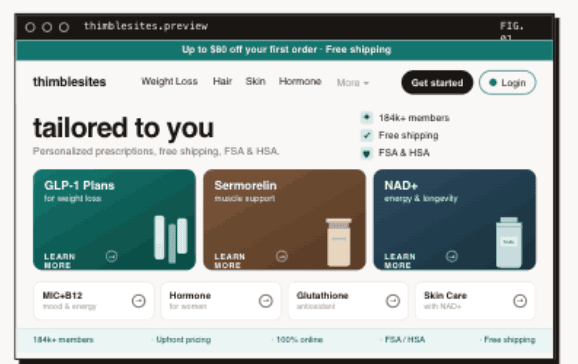
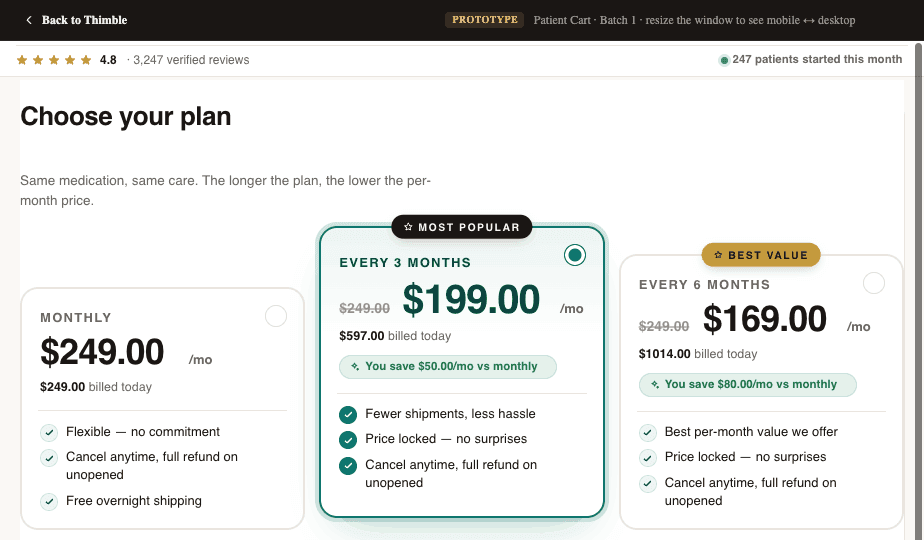
Thimble Hub is priced as a build fee plus an ongoing platform fee, with per-order fees that step down at higher volume. See /pricing for current numbers and the calculator at /calculate to model your specific patient and AOV mix.
Labor Savings
- Automated checkout-to-provider handoff eliminates 8-12 hours/week of manual work
- Integrated automation reduces follow-up workload by 40-60%
- Unified analytics eliminates the need for separate BI tools
Revenue Impact
- Our clients have seen 15-25% conversion improvements with high-performance sites (90+ Lighthouse) compared to template sites
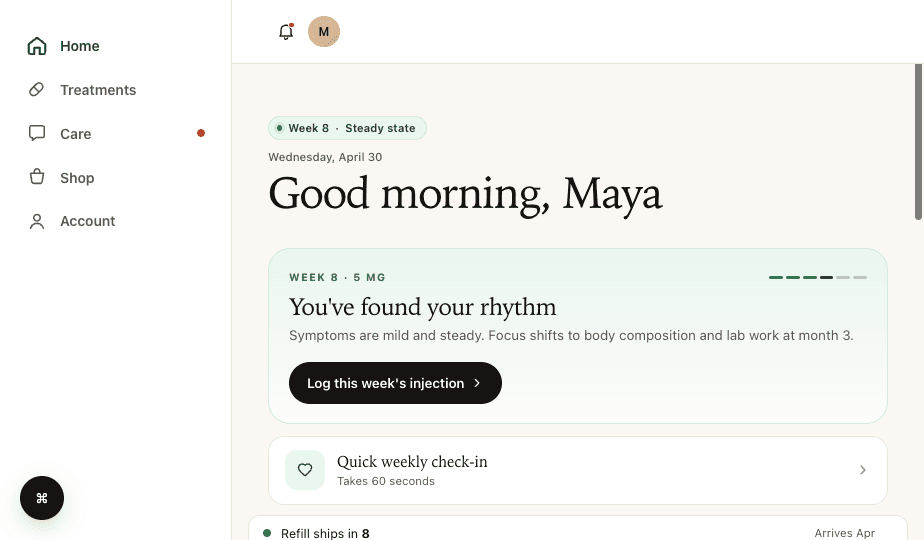
- In programs we've built, clinics with full-featured portals see retention rates above 80%, compared to roughly 30% for clinics relying on email and phone follow-ups
- Automated recovery workflows recapture 15-20% of failed payments
Total Cost of Ownership: A Side-By-Side
For a 10-provider clinic running a GLP-1 program with 500 active patients, here's the total picture over 12 months:
DIY Patchwork
- Direct platform: $36,000/year
- Labor overhead: $24,000/year
- Lost revenue from churn and conversion: $80,000-$150,000/year
- Total cost: $140,000-$210,000/year
Enterprise All-in-One
- Direct platform: $96,000/year + $40,000 setup
- Professional services for customization: $30,000/year
- Opportunity cost from slow iteration: Hard to quantify, typically 5-10% of revenue
- Total cost: $166,000-$200,000/year in year one, $126,000/year ongoing
Modular Infrastructure
- One-time build fees (varies by modules and scope - see pricing for ranges)
- Minimal ongoing labor overhead: $6,000/year
- Revenue uplift from better conversion and retention: $60,000-$120,000 added
- Net cost (after revenue uplift): Highly favorable compared to DIY or enterprise - actual figures depend on your module selection and scope
How to Budget for Telehealth at Your Clinic
- 01.Start with your patient economics: What's your average patient LTV? Your current churn rate? Your acquisition cost? Your budget should be sized to protect and grow these numbers
- 02.Calculate labor honestly: How many hours per week does your team currently spend on manual workflows? Multiply by loaded hourly cost. That's your hidden labor expense
- 03.Factor in patient churn: If your retention rate is below 60%, you're losing real revenue. Budget should include infrastructure that addresses the churn causes
- 04.Avoid per-seat pricing traps: If your platform charges per provider, you're paying more as you grow. Flat pricing scales with revenue, not headcount
- 05.Build in flexibility: Annual contracts with monthly billing give you leverage. Multi-year lock-ins remove your ability to adapt
Frequently Asked Questions
- How much does telehealth cost for a 5-provider clinic?
- Direct platform costs range from $1,500 to $6,000 per month depending on whether you use a DIY stack, enterprise platform, or modular infrastructure. Total cost of ownership (including labor and lost revenue) is typically 2-3x the direct platform cost.
- Is it cheaper to build my own telehealth stack with Zapier and free tools?
- On paper, yes. In practice, almost never. DIY stacks typically cost $4,000-$8,000/month in total when you include staff labor for integration work and lost revenue from patient churn. The direct platform savings are consumed by hidden costs.
- Why do enterprise telehealth platforms charge so much?
- Enterprise platforms are priced for large health systems with complex compliance requirements, custom workflows, and extensive integration needs. For small clinics, you're paying for enterprise features and scale you won't use.
- What's a realistic budget for a 10-provider telehealth clinic?
- With a modular stack (checkout, portal, and website infrastructure), costs are structured as one-time build fees that vary by scope - not ongoing monthly platform fees. Expect meaningful revenue uplift from better conversion and retention. Talk to us for a scoped estimate based on your specific program.
- How do I avoid paying for features I don't need?
- Choose modular infrastructure over all-in-one platforms. Pay for checkout when you need checkout. Pay for a portal when you need a portal. Modular pricing means you only pay for the components that drive your business.
Building a telehealth brand?
Thimble Hub gives you the checkout, intake, patient portal, and EHR-routing infrastructure so you can launch in weeks, not quarters. Modular, HIPAA-ready, no lock-in.