

There are approximately 7,500 503A compounding pharmacies and approximately 70-130 FDA-registered 503B outsourcing facilities in the US (verify current counts at the FDA's registered outsourcing facility list at fda.gov). They compound medications that retail pharmacies cannot produce: custom hormone formulations, personalized skincare, peptides, sublingual troches, specialty dosage forms. They have the clinical expertise, the pharmacy licenses, the raw materials, and the compounding equipment.
What most of them don't have is a way to reach patients directly. They operate behind the scenes, filling prescriptions sent from telehealth companies and clinics. The telehealth brand collects the patient, manages the subscription, owns the relationship, and takes the majority of the margin. The pharmacy does the compounding and ships the product.
That model is changing. The semaglutide boom of 2023-2025 taught hundreds of compounding pharmacies what compounding pharmacy DTC economics look like. Many built rudimentary patient-facing capability (Stripe checkout, Calendly for consultations, a Typeform for intake). Now they want to scale it. The infrastructure gap is what's holding them back.
Why Compounding Pharmacies Are Going Direct to Consumer
The Margin Problem
When a compounding pharmacy fills prescriptions for a DTC telehealth brand like Hims or Ro, the pharmacy captures a fraction of the total patient revenue. The telehealth brand charges the patient $150/month for compounded semaglutide. The pharmacy receives $30-50 for compounding and shipping. The brand keeps $100-120 for patient acquisition, the portal, and the clinical encounter.
When that same pharmacy operates its own DTC brand, it captures the full $150. Even after platform costs and provider network fees, the margin improvement is 2-4x.
The Relationship Problem
In the B2B model, the pharmacy has no relationship with the patient. The telehealth brand owns the patient data, the subscription, and the loyalty. If the brand switches pharmacy partners (which happens regularly, especially during supply disruptions), the pharmacy loses all that volume overnight. DTC gives the pharmacy a direct patient relationship that doesn't depend on a single B2B client.
The Semaglutide Wake-Up Call
The GLP-1 compounding boom taught pharmacies that patient demand for compounded medications is enormous. Empower Pharmacy reportedly hit a $1 billion+ revenue run rate during the semaglutide peak. But when the FDA resolved the shortage and sent dozens of warning letters to GLP-1 compounders, pharmacies that depended entirely on B2B semaglutide contracts were exposed. The ones that had built their own DTC channels had optionality. The ones that hadn't had to scramble.
What a Compounding Pharmacy DTC Brand Looks Like
The pharmacy doesn't need to become a technology company. It needs a technology layer that connects its compounding capability to patients. Here is the stack:
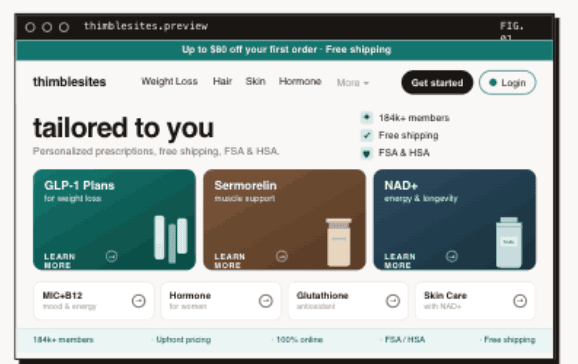
- 01.Branded website: A conversion-optimized site that presents the pharmacy's products (HRT, skincare, men's health, longevity) under the pharmacy's brand. Not a generic template. A real brand.
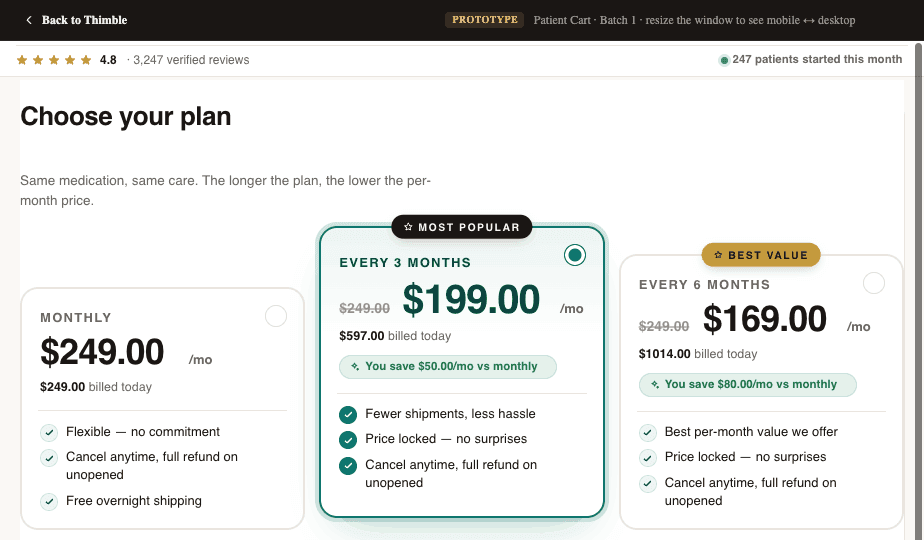
- 02.Intake and checkout: Patients select their treatment, complete a medical questionnaire, and pay. The intake system captures everything the prescriber needs for a clinical decision.
- 03.Provider network: Licensed prescribers in the patient's state review the intake and issue prescriptions. The pharmacy doesn't need to hire physicians. It connects to an existing telehealth provider network (Wizlo, OpenLoop, MDI, CareValidate) through the platform.
- 04.Prescription routing: The prescription routes back to the pharmacy itself for compounding. The pharmacy fills its own prescriptions. This is the critical difference from the B2B model: the pharmacy is both the platform operator and the fulfillment partner.
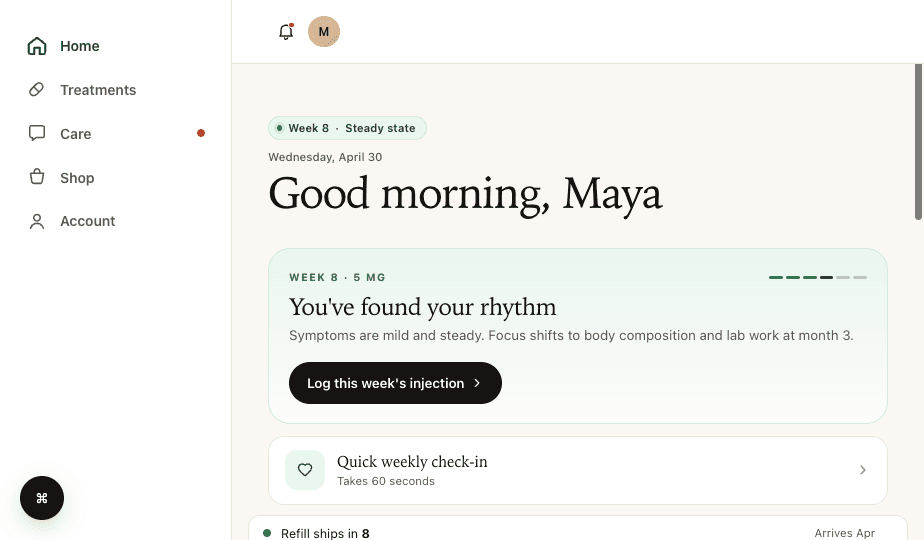
- 05.Patient portal: Patients access a branded portal to track their treatment, manage their subscription, request refills, and message their care team.
- 06.Refill automation: The system handles recurring prescriptions, payment processing, renewal consultations, and fulfillment triggers. The pharmacy compounds and ships when the refill cycle triggers.
The Verticals Where Pharmacy DTC Works Best
- Bioidentical HRT: The highest-value pharmacy DTC vertical. Custom compounded estradiol, progesterone, testosterone, DHEA formulations (rough pricing estimate: $100-250/month; varies by formulation and market). Retail pharmacies cannot produce these. Patients need a compounding pharmacy. If that pharmacy is also the brand, it captures the full value chain.
- Prescription skincare: Compounded tretinoin, azelaic acid, hydroquinone formulations (rough estimate: $25-75/month). High volume, straightforward compounding. Monthly refill subscription.
- Men's health: Compounded ED chewables (sildenafil/tadalafil troches), topical finasteride/minoxidil, and TRT (testosterone cypionate). Subscription-based, high retention.
- Longevity: NAD+ injectable, sermorelin, low-dose naltrexone. Higher price points (rough estimate: $150-400/month) for a committed patient base.
- Veterinary compounding: Many 503A pharmacies already compound pet medications. The same DTC model applies: pet owner intake, vet telehealth encounter, prescription, the pharmacy compounds, and ships. Pet medication delivery is an underserved niche with growing demand from pet owners seeking convenience.
Regulatory Considerations for Pharmacy DTC
- State pharmacy board rules: Some states restrict pharmacies from advertising directly to consumers for prescription medications. Review your state board's advertising regulations before launching a DTC brand.
- Corporate Practice of Medicine (CPOM): The pharmacy cannot make clinical decisions. The prescribing must be done by independent licensed providers. The platform must clearly separate the pharmacy's commercial role from the clinical decision-making.
- 503A vs 503B distinction: 503A pharmacies compound patient-specific prescriptions and are regulated primarily by state pharmacy boards. 503B outsourcing facilities can produce larger batches without patient-specific prescriptions, are FDA-inspected, and must meet current Good Manufacturing Practice (cGMP) requirements. The DTC model works for both, but 503A pharmacies must have a valid, patient-specific prescription before compounding. The platform handles this by routing the telehealth encounter before the prescription reaches the pharmacy.
- FDA scrutiny: The FDA has increased oversight of compounding pharmacies since the semaglutide enforcement actions of 2024-2025. Ensure your compounding practices are fully compliant with current cGMP requirements, state board regulations, and federal law.
- Telehealth prescribing: The providers prescribing for your DTC patients must be licensed in the patient's state and follow that state's telehealth prescribing rules. The platform handles state-by-state compliance for provider routing.
The Economics: B2B Fulfillment vs DTC Brand
- B2B fulfillment: Pharmacy receives $30-60 per fill from the telehealth brand. No patient relationship. Volume depends on a single B2B client. Margin: 15-25%.
- DTC brand: Pharmacy charges the patient $100-250/month (depending on vertical). After platform infrastructure costs (see /pricing), provider network fees ($8-25/encounter), and marketing: the margin improvement over B2B can be significant. Pharmacy owns the patient relationship and the subscription.
- Break-even math: Provider network fees and marketing are the main ongoing costs. With a growing patient base, the per-patient infrastructure cost decreases as fixed costs are spread across more patients.
PCCA Member DTC: How Members Can Launch Pharmacy Direct to Consumer
PCCA (Professional Compounding Centers of America) supplies raw chemicals, equipment, and education to 4,000+ member pharmacies. PCCA member DTC is a natural next step: PCCA gives you everything you need to compound. What PCCA does not provide is patient-facing technology. That is the gap prescription commerce infrastructure fills, and why pharmacy direct to consumer is increasingly a question PCCA members are asking.
- 01.Identify your strongest therapeutic vertical (HRT, skincare, men's health) based on your existing compounding volume and clinical expertise
- 02.Partner with a telehealth provider network for the clinical encounters (or build your own provider team if you have the licensure)
- 03.Configure your DTC brand on prescription commerce infrastructure: branded site, intake, checkout, provider routing, patient portal, refill automation
- 04.Route prescriptions back to your own pharmacy for fulfillment. You are both the brand and the pharmacy.
- 05.Launch to a small patient cohort (20-50 patients) and validate the full pipeline before scaling marketing
Frequently Asked Questions
- Can a compounding pharmacy legally operate a DTC brand?
- Yes, with important caveats. The pharmacy can operate the commercial side (brand, website, billing, fulfillment). The clinical decision-making (prescribing) must be performed by independent licensed providers, not the pharmacy. The platform separates these roles by routing patients through a telehealth provider network before the prescription reaches the pharmacy. Review your state pharmacy board's advertising regulations before launching.
- How much does it cost a pharmacy to launch DTC?
- Platform infrastructure pricing is on /pricing. Provider network fees run $8-25 per encounter. Marketing costs vary by channel and vertical. The pharmacy's compounding capacity and existing inventory are the main assets; platform infrastructure is the marginal investment to reach patients directly.
- Does the pharmacy need to hire doctors?
- No. The platform connects to existing telehealth provider networks (Wizlo, OpenLoop, MDI, CareValidate) that supply licensed prescribers in all 50 states. The pharmacy does not employ the providers. The providers operate independently and make clinical decisions based on patient intake data.
- What verticals work best for pharmacy DTC?
- Bioidentical HRT has the highest subscription value ($100-250/month) and requires compounding by definition. Prescription skincare has the highest volume and simplest clinical requirements. Men's health (ED, hair loss) has proven DTC demand. Choose the vertical that aligns with your existing compounding expertise and capacity.
- How does PCCA member DTC work with existing PCCA membership?
- PCCA provides the compounding chemicals, equipment, and education. Thimble Portal provides the patient-facing technology layer: intake, checkout, provider routing, patient portal, and refill automation. The two are complementary. PCCA helps you compound; Thimble Portal is the pharmacy direct to consumer layer that gets patients to your door and keeps them on subscription. Your PCCA formulary becomes your DTC product catalog.
Building a telehealth brand?
Thimble Hub gives you the checkout, intake, patient portal, and EHR-routing infrastructure so you can launch in weeks, not quarters. Modular, HIPAA-ready, no lock-in.